Editor’s Note: This analysis is from the Center on Budget and Policy Priorities. We are sharing their article to highlight how the One Big Beautiful Bill Act could raise energy costs.
The Republicans’ harmful megabill, enacted through budget reconciliation on July 4, will raise costs for New Jersey families and take health coverage, food assistance, and other essentials away from New Jerseyans who are already struggling to make ends meet — all while showering ever larger tax breaks on the wealthiest households.
While parts of the law do not require immediate implementation and federal guidance and state implementation will affect the full impact of some provisions, many of the 1.77 million New Jerseyans who get health coverage through Medicaid and the 827,000 New Jerseyans who receive food assistance from the Supplemental Nutrition Assistance Program (SNAP) will be at risk of losing this assistance that helps them meet their basic needs. Both programs are slated for enormous cuts — well over $1 trillion in total.
Slashing this assistance will hurt a broad swath of families across rural, urban, and suburban parts of the state. For example, based on Congressional Budget Office nationwide estimates, CBPP projects 324,000 New Jerseyans will lose health coverage and become uninsured in 2034 under the law’s provisions, as well as its failure to extend important tax credits for health coverage.
324,000 people in New Jersey will lose health coverage
Slashing this assistance will hurt a broad swath of families across rural, urban, and suburban parts of the state. For example, based on Congressional Budget Office nationwide estimates, CBPP projects 324,000 New Jerseyans will lose health coverage and become uninsured in 2034 under the law’s provisions, as well as its failure to extend important tax credits for health coverage.
Raises Costs and Increases Hardship for New Jerseyans
Takes health insurance away from New Jerseyans and makes it more costly
- Creates more red tape and barriers to coverage through harsh new Medicaid work requirements that could leave as many as 399,000 New Jerseyans in the expansion population at risk of losing health coverage, including for parents with children over age 13.
- Fails to continue the enhanced premium tax credits that help low- and middle-income families and small business owners afford health coverage, resulting in skyrocketing premium costs for New Jerseyans. For example, a 60-year-old New Jersey couple making $82,000 would see their annual premiums for a benchmark plan increase from $6,970 to over $25,076. Additionally, 75,000 New Jerseyans could lose health coverage because of high premium costs due to the new law’s failure to extend these tax credits.
- Takes away Medicare, federal funding for Medicaid and the Children’s Health Insurance Program, and affordable ACA marketplace coverage from people who have been granted humanitarian protections, including refugees, people granted asylum, and certain victims of domestic violence or sex or labor trafficking, among others living lawfully in the U.S.
- Cuts the federal funding states receive for emergency medical services provided to individuals who would qualify for the Medicaid expansion if not for their immigration status.
Raises the cost of groceries for some New Jerseyans
- Requires most states for the first time to pay between 5 to 15 percent of SNAP food benefit costs, which could force between $96 million and $287 million in new costs onto New Jersey. If New Jersey lawmakers can’t meet this unfunded mandate, they will have to either reduce the state’s costs by cutting the number of people who get SNAP, or opt out of SNAP entirely, which would leave New Jerseyans without the food assistance they need to buy groceries and would negatively impact grocers, especially in rural communities.
- 75,000 New Jerseyans will be at risk of losing some of their food assistance, including many children, under a significant expansion of SNAP’s already harsh, ineffective, and red tape-laden work requirements to parents and other caretakers of children aged 14 and up and adults aged 55 to 64. In addition, New Jersey will only be able to waive the work requirement in areas where the unemployment rate exceeds 10 percent, even during a recession when unemployment rises significantly but does not meet this extremely high level. The new law also eliminates the current exemption to the work requirement for veterans, people experiencing homelessness, and youth who recently aged out of foster care. (The new law does provide some protections for certain people who are American Indians or Alaska Natives.)
- Takes away food assistance from people who have been granted humanitarian protections, including refugees, people granted asylum, and certain victims of domestic violence or sex or labor trafficking, among others living lawfully in the U.S. In 2023, roughly 1,000 New Jerseyans participated in SNAP who were admitted as refugees, granted asylum, or granted withholding of removal.
Passes the buck to New Jersey lawmakers
States pay up to 15% of SNAP benefit costs
- This extreme legislation makes enormous cuts to food assistance and health care in part by shifting substantial new costs onto state governments. This includes requiring states to absorb a portion of SNAP benefit costs for the first time ever, cutting federal funding for state administrative costs in SNAP, implementing new forms of red tape that will increase uncompensated care costs, and restricting how states can fund their Medicaid programs, including through provider taxes. These higher costs will be hard for New Jersey to shoulder even when times are good, let alone when finances are strained.
Increases energy prices while cutting jobs
- To partially offset its roughly $4.5 trillion in regressive tax cuts, the new law includes $480 billion in cuts to clean energy tax credits, which will raise the cost of installing wind and solar, the lowest-cost energy. These cuts could cause two-thirds of planned projects nationwide to be canceled and could lead to annual household energy prices increasing by roughly $430 and 13,000 jobs lost in New Jersey in 2035.
Delivers Massive Tax Cuts to the Wealthiest New Jerseyans While Failing to Deliver Support to Working Families and Children
Gives more tax cuts to the wealthy
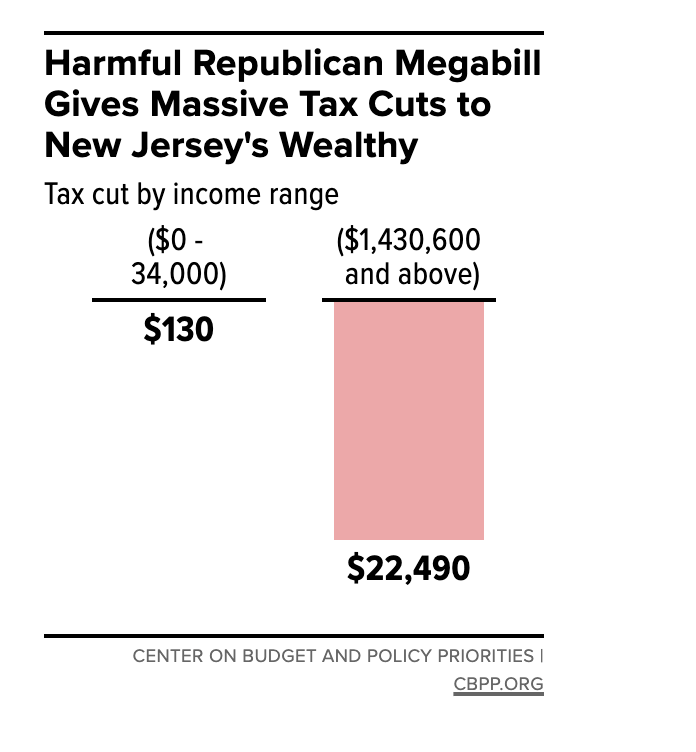
- In 2026, this tax plan gives the richest 1 percent of New Jerseyans, earning more than $1.43 million a year, an annual tax cut of $22,490. In contrast, the lowest-income New Jerseyans, earning less than $34,000, will receive only $130, while also bearing the brunt of deep cuts to Medicaid and SNAP and facing higher prices due to the President’s tariffs.
Leaves children in lower-income working families behind
- As many as 342,000 children in New Jersey will get nothing from the $200-per-child increase in the Child Tax Credit because their parents — who often work important but low-paid jobs — don’t earn enough.
- Takes away eligibility for the Child Tax Credit from U.S. citizen children and those with lawful status with a requirement that at least one parent have a Social Security number, which affects roughly 85,000 children in New Jersey by one estimate.
Sources: - Medicaid/CHIP Enrollment by Age by 119th Congressional District, CBPP
- A Closer Look at Who Benefits from SNAP: State-by-State Fact Sheets, CBPP
- By the Numbers: Republican Reconciliation Law Will Take Health Coverage Away From Millions of People and Raise Families’ Costs , CBPP
- Estimated Increase in Uninsured Due to 2025 Reconciliation Law and Expiration of Enhanced Premium Tax Credits, CBPP
- Medicaid Work Requirements Will Take Away Coverage From Millions: State and Congressional District Estimates, CBPP
- Premium Tax Credit Improvements Must Be Extended to Prevent Steep Rise in Health Care Costs, CBPP
- Who Benefits from Enhanced Premium Tax Credits in the Marketplace?, Urban Institute
- Research Note: Senate Republican Leaders’ Proposal Risks Deep Cuts to Food Assistance, Some States Ending SNAP Entirely, CBPP
- Senate Agriculture Committee’s Revised Work Requirement Would Risk Taking Away Food Assistance From More Than 5 Million People: State Estimates, CBPP
- Assessing Impacts of the “One Big Beautiful Bill Act” on US Energy Costs, Jobs, Health, and Emissions, Energy Innovation Policy & Technology LLC
- Analysis of Tax Provisions in the Senate Reconciliation Bill: National and State Level Estimates, ITEP
- Policymakers Should Expand the Child Tax Credit for the 17 Million Children Currently Left Out of the Full Credit, CBPP
- Nearly 3 Million U.S. Citizens and Legal Immigrants Initially Excluded under the CARES Act Are Covered under the December 2020 COVID-19 Stimulus, MPI
- Program Participation Data Dashboard, EITC and CTC Claims, By State and 119th Congressional District, CBPP