
Editor’s Note: This analysis is from the Center on Budget and Policy Priorities. We are sharing their article to highlight how the One Big Beautiful Bill Act could raise health care costs for veterans
House Republicans’ budget reconciliation legislation would take away health coverage and food assistance from many millions of people, including veterans. One out of every four veterans lived in a household receiving food assistance from the Supplemental Nutrition Assistance Program (SNAP) or health coverage from Medicaid or Children’s Health Insurance Program (CHIP) at some point in 2023.
Veterans could be particularly harmed by Medicaid and SNAP cuts given the complexity of their health care needs and their higher prevalence of food insecurity compared to non-veterans. Additionally, an estimated 680,000 children of working veterans would be left out of the bill’s expanded $2,500 Child Tax Credit. The so-called “Big Beautiful Bill” is anything but beautiful; it would cause widespread harm by making massive cuts to Medicaid, Affordable Care Act (ACA) marketplace coverage, and SNAP, which would raise costs and make it much harder for people to afford the high cost of groceries and health care.
SNAP, Medicaid, and ACA Marketplaces Provide Essential Support to Veterans
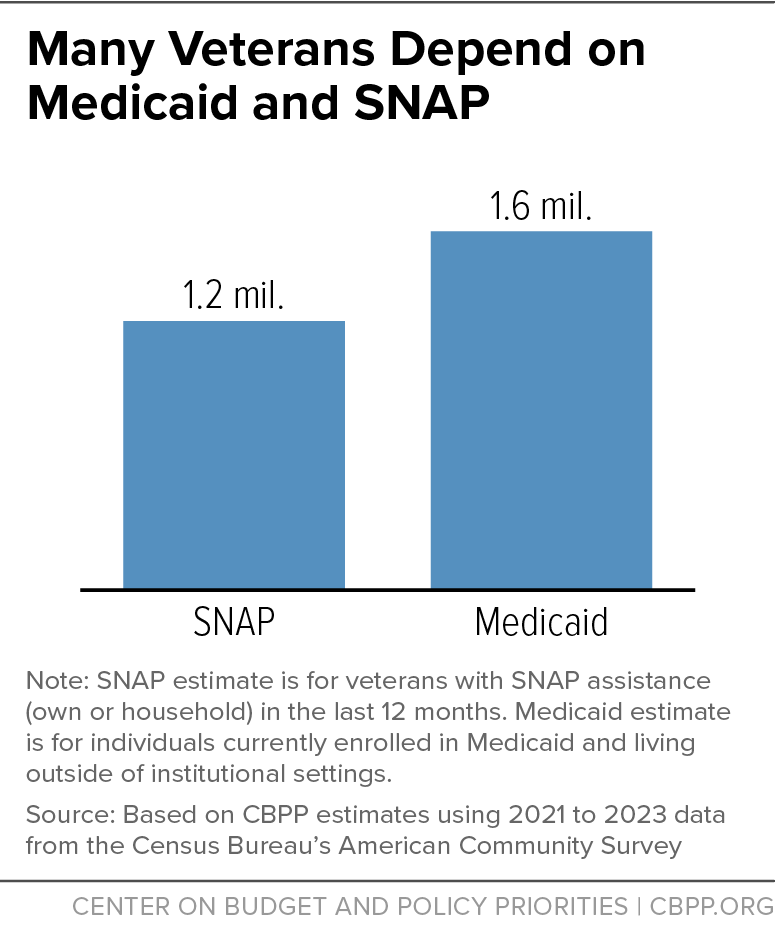
About 1.2 million veterans live in households that receive food assistance through SNAP, based on Census survey data. Thousands of veterans in every state — who may be between jobs, working in low-paying jobs, or have disabilities — use SNAP to supplement their low income to afford food for themselves and their families.
Nearly 1.6 million veterans are enrolled in Medicaid, and others have purchased ACA marketplace coverage with premium tax credits. (Some veterans are not eligible for or aware of Department of Veterans Affairs (VA) services or do not live near a VA facility.) Another roughly 4 million family members of veterans are also enrolled in Medicaid or CHIP. In addition to veterans and their families who receive Medicaid and SNAP, tens of thousands of families and households with active-duty service members also receive this assistance.
Health Care Cuts Will Hurt Veterans and Their Families
Increasing costs for veterans in the ACA marketplaces and Medicaid. The House Republicans’ health agenda targets the ACA marketplaces, which provide coverage and financial assistance to more than 20 million people, including nearly 300,000 veterans. The legislation fails to extend the expiring enhanced premium tax credits for marketplace coverage, which will lead to skyrocketing premiums. Additionally, the bill would require cost sharing for people with income greater than the federal poverty level ($15,650 per year for an individual in 2025) who are enrolled in Medicaid through the ACA expansion, increasing costs for veterans and other enrollees.
Taking away Medicaid from people, including veterans, not meeting a work requirement. The House bill would take away coverage from low-income adults enrolled in the Medicaid expansion group, including veterans, who can’t document meeting rigid work requirements or show they qualify for an exemption. Even worse, it gives states the option to adopt an unlimited “lookback” period, meaning they could require people to report work hours far back into the past as a condition of qualifying for Medicaid. Up to 14 million people, including veterans, would be at risk of ultimately losing their health coverage under this work requirement, which would apply to individuals up to the age of 64.
Veterans can face unique barriers to employment such as little work experience outside of military service, trouble finding employment that matches their skills, and challenges from physical and mental health conditions related to their service. Work requirements don’t account for these realities, and they are laden with red tape that will make it hard for many veterans to document their employment or their eligibility for potential exemptions, including those related to their service-related health challenges.
Making it harder for people, including veterans, to maintain health coverage. The House Republican bill would require states to redetermine eligibility for enrollees in the Medicaid expansion group twice a year, instead of annually, starting with renewals due on or after December 31, 2026. This would add excessive red tape for enrollees as well as state agencies, which are likely to make more mistakes with the sharp increase in workload. Experience shows that people who still meet eligibility criteria will lose coverage and “churn” on and off Medicaid, leading to interruptions in people’s medications and treatments. Indeed, the Congressional Budget Office (CBO) estimated this provision would cut $53 billion in federal spending between fiscal years 2028 and 2034 as more frequent renewals would cause eligible enrollees to lose coverage.
Nutrition Cuts Will Hurt Veterans and Their Families
Forcing deep SNAP benefit cuts by radically altering SNAP’s funding structure. SNAP benefit costs have been fully federally funded for 50 years. The House reconciliation bill would fundamentally alter this structure by requiring states to pay for between 5 and 25 percent of benefit costs. If a state can’t make up for these massive federal cuts with tax increases or spending cuts elsewhere in its budget, it would have to cut its SNAP program (such as cutting eligibility or benefits or making it harder for people to enroll) or it could opt out of the program altogether. CBO estimates that states would cut or terminate benefits for about 1.3 million people in an average month due to this provision. The cuts to nutrition assistance could be far larger if more states than CBO projects deeply cut or end SNAP, and the risk of such cuts would rise during recessions, when state budgets are even more stretched.
Taking SNAP benefits away from veterans who don’t meet rigid work requirements. Under current SNAP rules, adults up to age 54 and without children in their homes are limited to three months of benefits out of every three years if they can’t document they are either meeting a 20-hour-per-week work requirement or are exempt. The House Republican bill would expand this harsh restriction to older adults aged 55-64 and to parents of children over the age of 6, while allowing exemptions for veterans (added under the Fiscal Responsibility Act of 2023) to expire in 2030 and significantly limiting waivers for areas with poor economic conditions.
CBO estimates that expanding the work requirement would cut SNAP by $92 billion through 2034 and would take food assistance away entirely from 3.2 million people in a typical month. Some 56,000 families with veterans would lose an average of $219 a month in food assistance as a result, the Urban Institute estimates.
Restricting SNAP benefit updates. The Republican House bill would restrict future updates of the Thrifty Food Plan, the basis for SNAP benefit levels, so it wouldn’t reflect current dietary guidance and the types of foods people eat. This would cut benefits for all participants, including veterans, by $37 billion over the next decade, according to CBO.